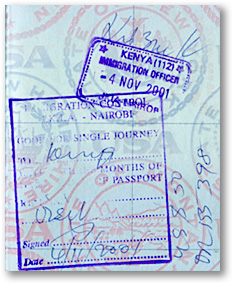
Kenya is a little complicated. I went there for a few weeks and ended up staying for a few months, in Jerusalem, one of the "estates" that surround Nairobi. With no disrespect intended to anyone I must say that, in all honesty, to an American the estates would look worse than any American slum, but in the context of Nairobi are more like suburbs; the real slums start further out, and I write about them at length in my December 10th journal entry. Why I stayed there, and for so long - well, as I said, it's complicated. I made friends. I tried to find something useful to do with my time and resources. I attempted to establish business relationships. But I think that mainly I just wanted to be somewhere utterly different than anywhere I'd ever been before, and to be there for long enough get a clear sense of what it was like to really be there.How I ended up living in Jerusalem specifically is also complicated.
Tabu - the Kenyan woman from the restaurant in Harare who had invited me to the funeral in Kenya (if that makes you go "Huh?", you might want to read the November 3rd entry in my journal and/or the bit on Zimbabwe) - had, it seems, been not completely straight with me about a lot of things. Where I would be staying in Nairobi for the week or so before the funeral, for instance.
The funeral was to take place in the village in which Tabu grew up, near Kisumo, and she had some business that she needed to take care of on her own first. While we were planning the trip she had told me that I'd be staying with an in-law of hers while in Nairobi until I left to join her and everyone else on the day of the funeral. But it soon became apparent that she had no intention of taking me to her in-law's house, and that she was, in fact, taking me to Nairobi knowing full well that we had nowhere specific to go once we arrived.
So. We landed in Nairobi, and instead of catching a taxi to the place I had been led to expect that we would, we caught one to Jerusalem, to the flat in which Tabu had at one point lived and which was at the time inhabited by two of the daughters of one of Tabu's deceased brothers-in-law, Nicole and Winnie (which I guess would make them nieces-in-law or something), as well as their four combined children and friend Stella. I wasn't particularly worried by this unexplained change in plans, mainly, I suppose, because it wouldn't have mattered if I were - bailing out of the taxi on the outskirts of Nairobi, at night and in the pouring rain, wasn't really a viable option - but I did begin to get the idea that Tabu wasn't being completely honest with me.
When we arrived at the flat it became clear to me that I really wasn't going to be staying with Tabu's in-law when, after some discussion between Tabu and Nicole in Swahili or Luo (Luo being the tribe to which they, and most of my Kenyan friends, belong), a hotel in town was suggested. Again, not really having many options, I smiled, said "Sure", and Tabu, Nicole and I got back in the taxi and headed in to town. But halfway to the hotel I learned that it was fifty bucks a night, way too much for my budget - not that I was looking for a free ride, but I would have been broke in three weeks at that rate, which was about how long I had been told we'd be staying in Nairobi - and I had to speak up, requesting that we find a cheaper place for me to stay. At that point Nicole immediately offered to let me stay at the flat for a few weeks, which was perfect. It was in fact what I had wanted from the moment I stepped out of the taxi in Jerusalem - not to stay in Nicole's flat specifically, but to stay there, in Jerusalem. I was trying to escape from hotels, and Jerusalem was a real Kenyan place, a neighborhood. And I will be forever grateful to Nicole, Winnie, and Stella for the complete hospitality which they offered me.
A few more details which I covered to some degree in my November 6th journal entry: The flat in Jerusalem is of some historical significance, as it is the one in which Jaramogi Oginga Odinga, one of the founders of post-colonial Kenya, had lived when he stayed in Nairobi. Nicole and Winnie's father had been one of Jaramogi's sons, as had Tabu's husband, and Beryl, the owner of the restaurant in Harare where I met Tabu, was one of his daughters. Two of Jaramogi's sons, Raila and Oburu, are still active in Kenyan politics. Which is another rather complicated affair - Kenyan politics, that is. At the time I was there it appeared possible that Raila might succeed Daniel arap Moi as president of Kenya, although that is not how it turned out. To me it all seemed very chaotic, with tribal allegiances as important as any other forces in the political process, and it has resulted in some very odd and tenuous alliances between former political foes. If you're interested, you can try to keep up with developments at The East African Standard. I check in occasionally, but often just end up confused.
So. The funeral came and went, and, having been made to feel very welcome and invited to do so, I opted to stay on in Jerusalem with the Odinga women instead of returning to Harare as originally planned. And that is the highly abridged version of the story of how I was afforded the utterly unique opportunity of living in Jerusalem.